After seeing the turmoil about Silicon Valley Bank and First Republic, people worry about if and how more financial carnage is yet to come. To provide some guidance, it is vital to assess who may be next to liquidate portfolios with large unrealised losses?
Besides banks with unhedged held-to-maturity portfolios or sudden deposit outflows (“bank run”), European life insurance companies could face similar liquidity issues (as mentioned by my colleagues a few weeks ago). In the last few years, the lower-for-longer expectations on interest rates led insurers to seek yield in illiquid assets and ultra-long (government) bonds. The latter increased the duration of their asset portfolio, i.e., the sensitivity to interest rate changes. While this would have worked well in an environment where interest rates stay low, insurers got caught on the wrong foot once rates increased much faster and stronger than they wished for. Now, those asset portfolios are substantially under water, with unrealised losses higher than their returns can compensate for in the foreseeable future.
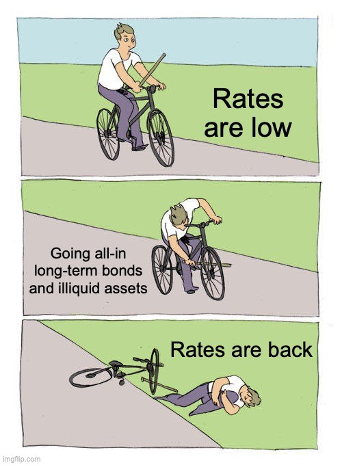
While unrealised losses are not a problem per se, they can turn out to be a real pain when rates stay sufficiently high for policyholders to realise that they get more attractive returns somewhere else. In this case, they increasingly surrender their policies, thus creating liquidity outflows which may force companies to realise their losses. This can create a dynamic similar to a bank run, which - once triggered - is difficult to contain. For a scientific analysis of this case, I recommend to have a look at the excellent study on life insurance convexity by the International Center for Insurance Regulation (ICIR) at Johann Wolfgang Goethe-Universität Frankfurt am Main, as well as the discussion paper on lethal lapses by Deutsche Bundesbank.
Although there is legitimate doubt that such a textbook-like scenario realises (e.g., due to administrative hurdles of surrendering a policy and regulatory backstop measures) - and it would be unprecedented in Europe - the risk of increased surrender is real also because policyholders see their savings rate evaporate due to inflation and need money to make their living. For example, consumers may need to decide between continuing their policies or paying their gas bill (as discussed during BaFin Jahreskonferenz 2022). Further, once a wide audience discusses the topic (see article in Le Monde from this week) trust in institutions can deteriorate quickly.
What can life insurers do to prevent mass surrender?
Life insurers have several measures at hand to retain policyholders and avoid increased surrender. From an asset-liability-management perspective, those are:
- Increasing the attractiveness of the existing policies, e.g., by increasing profit participation.
- Creating new attractive products to create liquidity inflow, e.g., by offering competitive returns using assets in dedicated (separated) cover fund. Further, surrender values should ideally reflect the risk of unexpected losses from held-to-maturity assets.
- Managing both duration and convexity of the asset portfolio to avoid being stuck with large unhedged losses.
While the first two can be implemented anytime soon, having a dynamic risk management of both duration and convexity in place takes time and is essential for the long-term. Together with my colleagues at Balance Re, we are supporting companies to overcome this challenge by offering asset-liability-management software, consulting, and outsourcing (incl. full risk transfer). Feel free to get in touch or leave a comment on this topic.